




Local News 🟡
7 Key Factors Affecting Gold Prices
- Published:
- Updated:
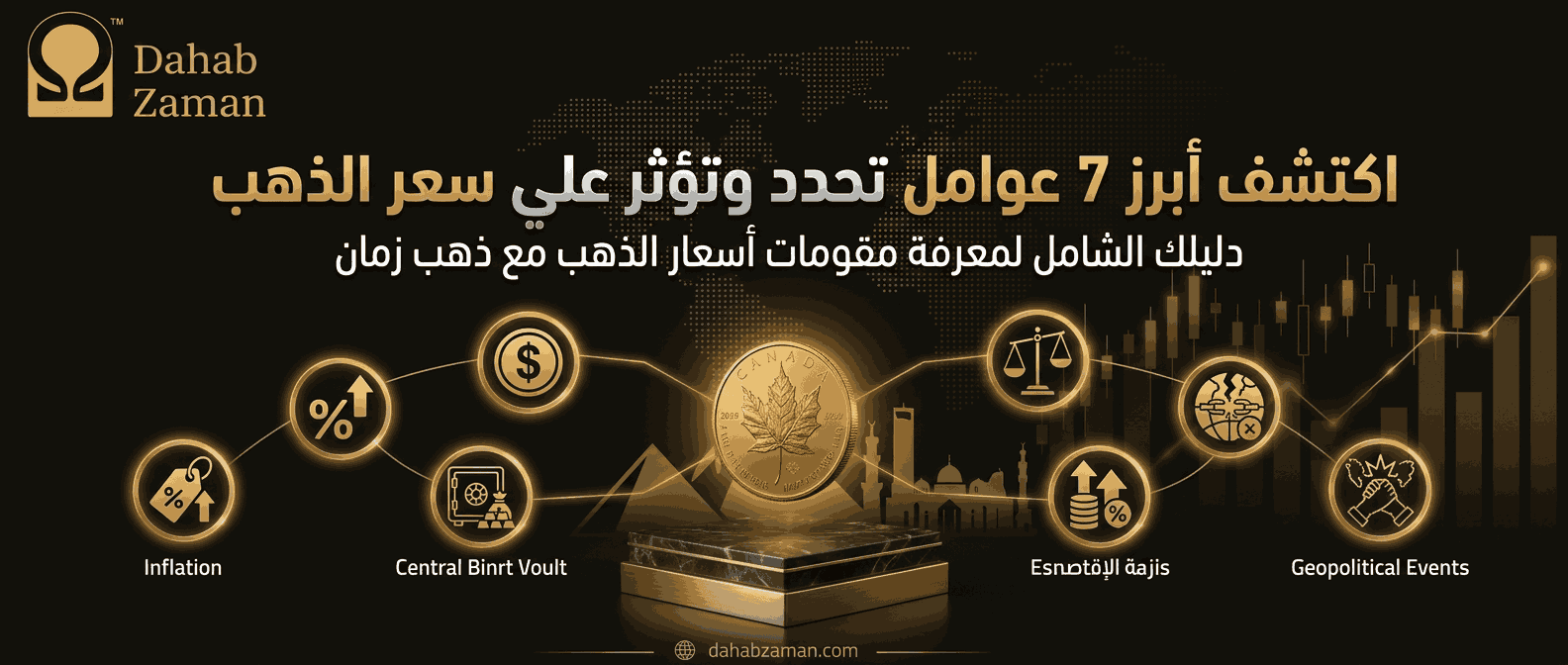
The key factors affecting gold prices include real interest rates, the US dollar, central bank purchases, geopolitical risk, and inflation expectations. These forces explain why gold has risen more than 80% since 2020 and why Egyptian buyers track the gold price today in Egypt every morning. Understanding how each factor affecting gold prices moves the market helps investors decide when to buy, hold, or sell, and which form of gold investment fits their goals.
Executive Summary: What Drives Gold Prices Today?
Gold trades on a global over-the-counter market with no single exchange setting the price. London, New York, Shanghai, and Dubai contribute to a continuous benchmark, while retail prices in Egypt follow the international spot price adjusted for the local dollar exchange rate.
The 7 Core Drivers at a Glance
The seven factors affecting gold prices most directly are:
- Real interest rates: the single most powerful long-term driver.
- US dollar strength: measured by the DXY index, inversely correlated.
- Inflation expectations: gold hedges purchasing power when prices accelerate.
- Geopolitical risk: wars, sanctions, and elections trigger safe-haven buying.
- Market risk: equity sell-offs and credit events push capital into bullion.
- Central bank purchases: sustained institutional demand from emerging-market reserves.
- Jewelry and industrial demand: physical consumption that anchors the spot price.
Real Yields vs. Nominal Yields: What Really Matters
Nominal yields are the headline rates published by central banks. Real yields are nominal yields minus expected inflation. Gold pays no coupon, so when real yields rise, holding gold carries a higher opportunity cost. When real yields fall, gold becomes attractive because it preserves purchasing power. Between 2020 and 2025, US 10-year real yields averaged close to 0.4%, while gold rose from USD 1,600 to more than USD 2,900 per ounce. Real yields remain the clearest of all factors affecting gold prices.
Gold and the Dollar: The Inverse Link
Because gold is priced in US dollars, any sustained move in the dollar index (DXY) shifts the price in other currencies. A weaker dollar makes gold cheaper for buyers using euros, pounds, rupees, or Egyptian pounds, lifting global demand. A stronger dollar does the opposite. This is one reason gold prices today in Egypt can move even when international spot prices appear flat.
Read also : Understanding the Economic Importance of Gold
1. Macroeconomic Drivers: Monetary Policy and Interest Rates
The macroeconomic backdrop sets the foundation for every other driver. Monetary policy, inflation, and currency moves lift or sink gold over months and years.
Fed Policy and the Power of Real Rates
The US Federal Reserve does not set the gold price directly, but its decisions shape the opportunity cost of holding bullion. When the Fed cuts rates or signals cuts ahead, real yields usually fall and gold tends to rally. When the Fed hikes aggressively, as in 2022-2023, real yields rose above 1.5% and gold corrected by roughly 20% from its peak. Investors who follow investing in gold in Egypt strategy watch the FOMC statement closely, because real rates are the most predictive of all factors affecting gold prices over the next 12 months.
Inflation Expectations vs. Reality
Gold's reputation as an inflation hedge is partly justified and partly overstated. In the short run, gold prices often move on expected inflation, not realized inflation. Surveys, breakeven rates on TIPS, and wage-growth data all influence this. When expectations rise but real rates stay low, gold rallies. When inflation proves higher than nominal rates can compensate, investors flee cash and bonds and seek refuge in investing in gold and silver as a parallel currency system.
Dollar Moves (DXY) and Currency Swings
The dollar index reached a multi-decade high in late 2022 and then entered a sustained downtrend as the US twin deficit widened. Each leg lower in the DXY has generally been accompanied by a leg higher in gold. For Egyptian buyers, this dynamic is amplified: the Egyptian pound has depreciated against the dollar over the long term, and currency translation effects are often the dominant of all factors affecting gold prices for local investors.
2. Geopolitical and Market Risk Drivers
Gold's second role is as a crisis hedge. While monetary policy moves gold in long arcs, geopolitical shocks can move it within days. Few factors affecting gold prices produce sharper moves than a crisis headline.
Safe-Haven Rush in Crises
Every major escalation of the past 25 years has produced a measurable spike in gold: the 2003 Iraq invasion, the 2008 financial crisis, the 2020 pandemic, and the 2022 Russia-Ukraine conflict. The pattern is consistent: investors rotate from equities and local-currency assets into gold, US Treasuries, and the Swiss franc. Crisis episodes are when the factors affecting gold prices align most predictably toward higher prices.
Recessions and Stock Market Chaos
Recessions are mixed for gold. Mild, rate-driven downturns often lift gold as the Fed pivots to easing. Severe credit-driven downturns, like 2008, can produce sharp short-term liquidity-driven sell-offs in every asset class, including gold. After the dust settles, gold typically outperforms. Investors who tracked the factors affecting gold prices through past cycles learned to add during the panic and trim into the recovery.
Debt Crises and Currency Collapses
When governments default or currencies collapse, gold provides a parallel store of value. Argentina, Turkey, Lebanon, and Zimbabwe have seen gold demand surge. Egyptian history offers a similar lesson from the 2016 and 2022 devaluations. Each round of currency adjustment was followed by a structural shift in demand for physical gold, which is why debt and currency regimes are persistent factors affecting gold prices for decades.
Discover more details on: gold bar making
3. Supply and Demand Dynamics
Monetary and geopolitical drivers explain the direction. Supply and demand fundamentals explain the magnitude. The gold market clears roughly USD 200-300 billion of physical demand per year, with mine production around 3,500 tonnes and recycled supply filling the gap.
Central Banks Loading Up on Gold
Central banks purchased a record 1,037 tonnes of gold in 2023, followed by similar volumes in 2024 and 2025, according to the World Gold Council. Leading buyers were China, India, Turkey, and Poland, with Egypt also adding to its reserves. This official-sector demand has structurally lifted the floor under gold prices and is one of the most important factors affecting gold prices over the past decade.
ETFs, Futures, and Bullion: Where Investors Put Money
Gold-backed ETFs, futures contracts on COMEX, and over-the-counter bullion together channel hundreds of billions of dollars of investment demand. ETF flows are highly responsive to real yields. The largest gold ETFs, such as SPDR GLD and iShares IAU, hold a combined 1,500+ tonnes and act as a transparent proxy for institutional sentiment.
Jewelry, Tech, and Industry: Everyday Gold Demand
Jewelry accounts for roughly half of annual gold demand, dominated by China, India, and the Middle East. Electronics and industrial catalysts make up another 10%. Jewelry demand is price-sensitive: when prices rise sharply, consumers shift to lighter pieces or 22-karat alloys. For Egyptian investors, wedding and savings traditions keep baseline physical demand strong, supporting a steady local market at established dealers such as Dahab Zaman. Physical demand is the slowest-moving of the factors affecting gold prices, but it sets the floor under drawdowns.
Mines, Recycling, and Scrap: The Supply Side
Global mine production has plateaued around 3,500 tonnes per year, with few new discoveries. New mines take 10-15 years from discovery to production, and ore grades are declining. Recycled gold acts as a flexible buffer: when prices rise sharply, more households sell old jewelry, increasing supply and partially dampening the rally.
Practical Decision Framework: When to Buy, Hold, or Sell Gold
Understanding the drivers is only half the task. Translating that knowledge into action separates successful investors from the rest.
Stagflation vs. Boom: Which Scenario Favors Gold?
Gold performs best in two regimes: stagflation (rising prices with stagnant growth) and crisis (recession combined with stimulus). In both cases, real yields fall and the dollar weakens. Gold underperforms during boom cycles with rising real rates and a strong dollar, the environment of 2013-2018. Identifying which regime you are in is the practical first step when reading the factors affecting gold prices.
Physical Gold vs. Paper Gold (ETFs and Futures)
Each form of gold investment has distinct advantages:
- Physical bars and coins: full ownership outside the financial system, immune to counterparty risk, ideal for long-term savings.
- ETFs: liquid, low-cost, easy to buy and sell, suitable for tactical allocation.
- Futures and mining stocks: leveraged exposure, higher risk, better for short-term traders than long-term savers.
Most experienced investors combine physical gold with ETFs for tactical flexibility. Beginners often start with investing in gold for beginners through a small allocation to 24-karat bars. For Egyptians, investing in gold in Egypt through certified dealers gives added benefit of local support and recognized hallmarking.
10-, 20-, and 30-Year Returns: What History Shows
Over the 30 years through 2025, gold returned an annualized average of roughly 7-8% in US dollars, with significantly higher returns in weaker-currency markets. Over 20-year windows, gold has outperformed cash and matched or beaten most bond portfolios. For Egyptians building generational wealth, a 15-20% allocation to physical gold, rebalanced annually, has historically delivered the best risk-adjusted returns and remains one of the best gold investment strategies for anyone who wants exposure to all factors affecting gold prices at once.
Frequently Asked Questions
Why Does Gold Sometimes Crash Suddenly?
Sharp gold drops usually follow three triggers: a sudden spike in real yields, a forced liquidation by large leveraged funds, or a rapid strengthening of the US dollar. The March 2013 and March 2020 sell-offs reflected liquidity events where margin calls forced positions closed across all assets. These crashes rarely reverse the long-term trend and often mark attractive entry points.
How Does Gold Behave When Rates Are High?
High nominal rates do not automatically hurt gold. What matters is real rates. If inflation rises faster than nominal rates, real rates fall and gold rallies, as occurred in 2024. If rates rise while inflation cools, real rates climb and gold tends to struggle. The current cycle, with rates above 4%, has been more challenging for gold than 2020-2021, but renewed Fed easing would quickly change that picture.
Does Jewelry Demand Really Move the Spot Price?
Jewelry demand alone rarely moves the international spot price because it is gradual and dispersed. In price-sensitive markets like India and China, jewelry demand creates a strong physical floor. When prices fall sharply, jewelry buyers accelerate purchases and tighten supply. This is why gold rarely collapses below the marginal cost of mine production.
How to Track Gold's Main Price Drivers in Real Time
The factors affecting gold prices shift quickly, and most professional investors monitor a small dashboard of indicators to keep up:
- US 10-year real yield (TIPS yield)
- Dollar index (DXY)
- Federal Reserve funds rate and dot plot
- ETF flows (SPDR GLD, iShares IAU)
- Central bank gold purchase reports from the World Gold Council
- Geopolitical risk index (GPR)
And also through our page : Gold Prices in Egypt Today
For local buyers tracking gold prices today, the international spot price is available on Kitco, Bloomberg, or the World Gold Council website. Local premiums depend on the dealer's sourcing and authenticity guarantees, which is why buying gold in Egypt through certified providers such as Dahab Zaman ensures purity and fair pricing.
Smart investors keep an eye on the structural factors affecting gold prices, rebalance their gold exposure annually, and avoid reacting to short-term volatility. The same principles apply whether you are learning about investing in gold for beginners or refining a mature portfolio: focus on real yields, the dollar, central bank demand, and the geopolitical backdrop. Reading the factors affecting gold prices is a skill, and like any skill, it compounds over time.
Ready to put this knowledge into action? Buy now from Dahab Zaman for certified investment-grade gold bars and gold coins in egypt, or contact our team for guidance on building a balanced gold allocation suited to your goals in Egypt. Once you understand the factors affecting gold prices, the daily noise stops being intimidating and becomes a signal you can use.
Topics
- gold